
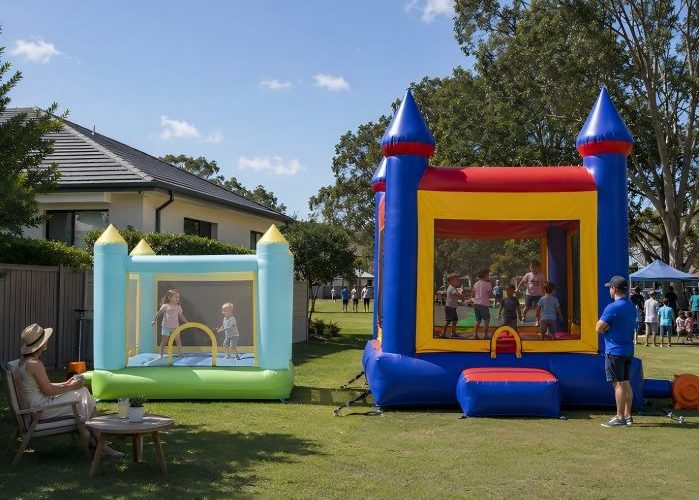
A residential jumping castle and a commercial jumping castle may look similar once inflated, but they are designed for very different patterns of use.
Residential models are generally intended for occasional entertainment at home. Commercial models are made for repeated setup, operation, cleaning and transport at parties, schools, community events and other venues.
The right choice is not simply the larger or more expensive option. It depends on how often the inflatable will be used, who will use it and how it will be moved, maintained and stored.
Commercial vs Residential: Quick Comparison
| Feature | Residential Jumping Castle | Commercial Jumping Castle |
|---|---|---|
| Intended use | Occasional home use | Regular events or hire use |
| Typical users | One family or a small group | Multiple customer groups |
| Construction | Usually lighter | Generally heavier-duty |
| Handling | Easier to carry and store | May require several people or equipment |
| Setup frequency | Occasional | Frequent |
| Cleaning | As required after home use | Usually checked and cleaned between hires |
| Initial cost | Generally lower | Generally higher |
| Best suited to | Backyard entertainment | Rental businesses and organised events |
These are general differences rather than fixed rules. Specifications vary between manufacturers and models, so the information provided for the exact inflatable should always take priority.
Why Construction Matters
The most important difference is not always visible in a product photograph.
Residential jumping castles are often made from lighter synthetic fabrics. This keeps the packed weight manageable and can make the inflatable easier for a household to move and store.
Commercial jumping castles are generally made from heavier-duty materials selected for repeated handling and event use. They may also include additional reinforcement in areas that receive frequent contact or movement.
These areas can include:
- Entrances and exit steps
- Jumping surfaces
- Slide lanes
- Climbing sections
- Anchor points
- Inflation tubes
- Floor seams
- Corners and connecting panels
A rental inflatable may be unrolled, inflated, anchored, used, deflated and packed several times in a week. A residential model might go through the same process only a few times each year.
That difference in frequency is one reason the two types should not be treated as interchangeable.
Construction quality also involves more than material thickness. Stitching, reinforcement placement, design, correct inflation and ongoing maintenance all influence how the jumping castle performs over time.
The Practical Differences Owners Notice
The biggest differences often become clear when the jumping castle is no longer inflated.
A lightweight residential model may fit into a household storage space and be manageable for one or two adults. A commercial inflatable can be considerably heavier and may require several people, a trolley or suitable lifting equipment.
Before choosing a commercial unit, consider the complete handling process:
- How will it be unloaded at the venue?
- How many people are needed for setup?
- What type of vehicle will transport it?
- Where will it be stored?
- Can the packed roll fit through the storage entrance?
- How will it be handled if it is wet after an event?
Inflated dimensions are important when assessing a venue, but packed dimensions and weight affect daily business operations.
A larger castle may attract attention and suit bigger events, but it can also increase transport, labour and storage requirements.
Cleaning and Maintenance
A residential jumping castle used by one household may only need cleaning after use and a final check before storage.
Commercial equipment may be used by different groups at several locations. This usually requires a more organised inspection and cleaning routine.
Before and after each hire, the operator should check high-contact and high-wear areas, including:
- Seams and stitching
- Entry steps
- Slide surfaces
- Climbing sections
- Anchor points
- Mesh panels
- Inflation tubes
- Areas where moisture or dirt can collect
The jumping castle should be completely dry before long-term storage. Packing it while damp can create unpleasant odours, staining or mould and may make future cleaning more difficult.
Commercial operators may also benefit from keeping inspection and repair records. These records can help identify recurring wear and make it easier to decide when a unit needs repair or replacement.
Blowers, Anchoring and Setup
Both residential and commercial jumping castles may use continuous airflow, meaning the blower remains running throughout use.
The correct blower depends on the individual model. A larger or more powerful blower does not increase the jumping castle’s permitted number of users or weight capacity. Only the blower configuration specified for the inflatable should be used.
Commercial operators should also plan for:
- Access to a suitable power supply
- Safe cable placement
- Protection from accidental disconnection
- Clear space around the blower
- Procedures for unexpected power loss
Anchoring requirements can also vary considerably. Commercial inflatables may have more anchor points because of their dimensions, height or design.
Every required anchor point should be used according to the operating instructions. The anchoring method must also be suitable for the ground surface and operating conditions.
A castle is not ready for use simply because it looks fully inflated. The surrounding clearance, ground condition, anchoring, blower position, weather and supervision arrangements must all be checked before the first user enters.
Which Type Should You Choose?
The intended use should guide the decision.
Choose a Residential Jumping Castle If:
- It will be used mainly by one household
- Use will be occasional
- Easy handling and compact storage are priorities
- It will not be offered for commercial hire
- Its stated user limits suit your family
A residential model can be a practical choice for supervised backyard entertainment when it is operated within the manufacturer’s instructions.
Choose a Commercial Jumping Castle If:
- It will be hired to customers
- Regular setup and transport are expected
- It will be used by different groups
- Structured cleaning and inspection are part of the operation
- A business needs equipment intended for repeated event use
A product purchased for occasional family use should not automatically be used for a rental business later. If the planned use changes, the suitability of the inflatable should be reassessed.
10 Questions to Ask Before Buying
Product photographs can show the theme and general layout, but they cannot provide all the information needed to evaluate a jumping castle.
For model-specific details such as packed weight, blower requirements and intended users, buyers can check directly with commercial suppliers, including East Inflatables Australia, before making a decision.
Ask these questions before buying:
- Is the jumping castle intended for residential or commercial use?
- What material is used in its construction?
- Which areas have additional reinforcement?
- What are the maximum user and weight limits?
- What are the inflated dimensions?
- What are the packed dimensions and packed weight?
- Which blower or blower configuration is required?
- How many anchor points does the model have?
- What inspection and maintenance information is supplied?
- What warranty and repair support is available?
Clear answers make it easier to compare more than appearance and purchase price.
Consider the Long-Term Cost
Residential models usually have a lower initial purchase price. For occasional family use, paying more for a commercial model may not be necessary.
A commercial jumping castle generally requires a larger investment, but hire operators should consider the total cost of ownership rather than the purchase price alone.
This can include:
- Transport
- Setup labour
- Cleaning time
- Storage
- Blower requirements
- Routine inspections
- Repairs
- Replacement parts
The cheapest inflatable is not always the least expensive to operate. Similarly, the most expensive model is not automatically the best choice for every rental business.
The most suitable option is one that matches the operator’s customers, venues, transport capacity and expected booking frequency.
Make the Decision Based on Real Use
Residential and commercial jumping castles may share similar colours, themes and features, but they are made for different purposes.
A residential model prioritises convenience for occasional home use. A commercial model is intended for the repeated transport, setup, operation and maintenance associated with organised events and hire businesses.
Before buying, look beyond the product photograph. Consider how often the jumping castle will be used, who will use it, how it will be transported and where it will be stored.
Choosing according to real operating conditions is more reliable than choosing according to appearance alone.