
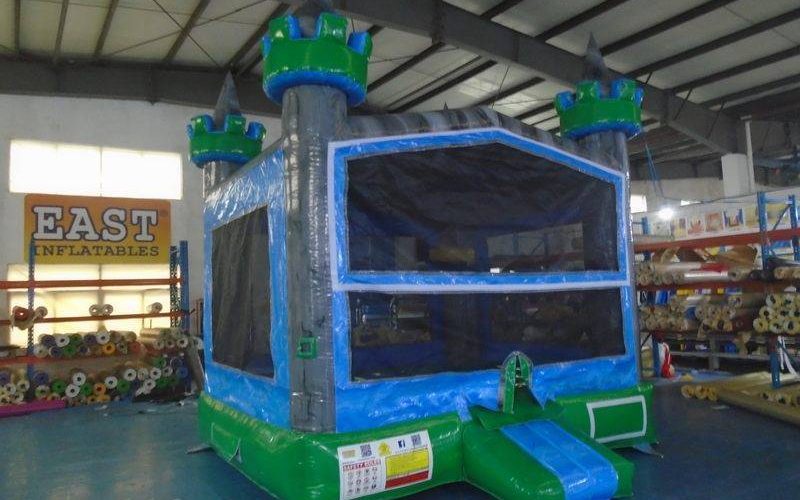
Correct anchoring is one of the most important parts of setting up a commercial jumping castle or inflatable amusement device. Even a professionally manufactured inflatable can move, overturn or become airborne if it is not properly secured, particularly during sudden weather changes or strong wind gusts.
In Australia, commercial inflatable operators should follow the manufacturer’s operating instructions, applicable work health and safety requirements, venue rules and the relevant provisions of AS 3533.4.1:2018 – Amusement rides and devices, Part 4.1: Specific requirements—Land-borne inflatable devices.
There is no single anchoring method, stake size or ballast weight suitable for every inflatable. The correct system depends on the inflatable’s size, height, exposed surface area, anchorage design, installation surface and local conditions.
This guide explains the main considerations when anchoring commercial jumping castles on grass, concrete, asphalt, artificial turf, timber decking and indoor floors.
1. Follow the Manufacturer’s Anchoring Instructions
Before setting up an inflatable, check its operating manual and anchorage information.
The documentation should identify:
- The number and location of all anchorage points
- The required type and dimensions of ground stakes
- The correct direction and installation angle of tie-down straps
- The required anchorage capacity or design loads
- The maximum operating wind speed
- Required safety clearances
- Emergency evacuation and deflation procedures
Every anchorage point intended to secure the inflatable should be used in accordance with the manufacturer’s instructions.
Do not assume that a method suitable for a small jumping castle will also be adequate for a tall inflatable slide, large obstacle course or inflatable park. Larger units and inflatables with greater exposed surface areas may require stronger anchorage arrangements.
If the original anchorage information is unavailable, or the specified method cannot be used at a particular venue, advice should be obtained from a competent person with suitable knowledge of inflatable devices and anchorage systems.
2. Anchoring Jumping Castles on Natural Grass
Natural grass is often the preferred surface because approved ground stakes can usually be installed directly into the soil. However, the holding strength of a stake depends on the ground condition, the stake specification and the way it is installed.
Inspect the Ground
Before installing any stakes, inspect the area for:
- Loose, sandy or waterlogged soil
- Extremely dry or cracked ground
- Recently filled or disturbed soil
- Tree roots
- Irrigation systems
- Underground electricity, gas, water or communication services
- Drains, pits and retaining structures
- Uneven or sloping ground
Permission may be required from the property owner or event organiser before driving stakes into the ground. Underground services should also be identified where necessary.
If the soil cannot provide reliable holding strength, move the inflatable to a more suitable location or use an alternative anchorage system approved by the manufacturer or a competent person.
Use Suitable Ground Stakes
Ground stakes must be fit for purpose and comply with the specifications provided in the manufacturer’s operating manual or anchorage design.
Do not replace approved commercial stakes with lightweight tent pegs, garden stakes, damaged steel rods or other unrated items.
The required stake length, diameter, shape and material can vary according to the inflatable, expected anchorage forces and condition of the ground.
Install and Protect the Stakes
Install each stake at the angle, depth and orientation specified by the manufacturer. The anchoring strap must remain securely connected and should not be able to slide off the stake.
Exposed stake heads can create trip, impact and puncture hazards. Stakes and connecting hardware should therefore be positioned or protected so they cannot injure users, attendants or members of the public.
3. Anchoring on Concrete, Asphalt and Paved Surfaces
Ground stakes generally cannot be used on concrete, asphalt or paved areas. In these situations, operators may need an engineered ballast system, approved mechanical anchors or another method specified by the manufacturer.
A hard-surface anchorage system should be capable of resisting the same design forces required of the original ground-stake system.
Avoid Universal Ballast Calculations
There is no universal ballast weight suitable for every inflatable or anchorage point.
The effectiveness of a ballast system depends on more than its total weight. Other important factors include:
- Friction between the ballast and the surface
- The direction and angle of the tie-down strap
- Horizontal sliding forces
- Vertical uplift forces
- Dynamic wind loads
- The height of the attachment point
- The shape and stability of the ballast
- The possibility of the weight tipping or moving
The required ballast should be specified by the manufacturer or determined by a competent person for the particular inflatable and installation conditions.
Suitable Ballast Systems
Depending on the approved design, suitable systems may include:
- Heavy-duty commercial sandbags
- Rubber-covered ballast blocks
- Engineered concrete weights
- Fully filled commercial water ballast tanks
- Purpose-designed mobile anchorage systems
- Approved permanent mechanical anchors
Ballast units should be stable and secured against sliding, tipping or accidental movement. They should also be positioned or protected so they do not create a hazard for users or members of the public.
Loose bricks, garden furniture, vehicles, partially filled buckets and other improvised objects should not be used as substitutes for a properly designed anchorage system.
Permanent Anchors
Permanent floor or pavement anchors may be appropriate at venues where inflatables are installed regularly.
Drilling should only be carried out with the property owner’s permission, after checking for underground services, reinforcement and waterproofing membranes. The proposed anchors and supporting surface must have sufficient capacity for the required loads.
4. Anchoring on Artificial Turf
Artificial turf should normally be treated as a hard surface unless the property owner has confirmed that ground stakes can be installed safely.
Driving stakes through artificial turf could damage:
- Synthetic grass fibres
- Turf backing
- Shock-absorbing pads
- Drainage layers
- Irrigation systems
- Waterproof membranes
- Underground services
- The base underneath the turf
Where staking is not permitted, use an approved ballast system based on the manufacturer’s anchorage requirements.
Protective rubber mats may be placed beneath ballast units to reduce damage to the turf and help prevent movement. Any protective material must remain flat and should not create a trip hazard.
Written approval should be obtained before penetrating artificial turf or attaching straps to surrounding structures.
5. Setting Up on Timber Decking
Timber decking can present additional challenges because deck boards, handrails and balustrades may not have sufficient capacity to resist inflatable anchorage forces.
Never attach anchoring straps to:
- Decorative handrails
- Balustrades
- Timber pickets
- Lightweight posts
- Outdoor furniture
- Temporary fences
- Unverified structural members
An inflatable should only be connected to a deck structure when the proposed anchorage points and their capacity have been approved by the venue owner and, where necessary, a competent engineer.
If suitable structural anchorage is unavailable, an approved freestanding ballast system may be required. The deck should also be checked to confirm it can support the combined weight of the inflatable, ballast, equipment, operators and users.
6. Anchoring Commercial Inflatables Indoors
Indoor inflatables are not exposed to normal outdoor wind loads, but they must still be restrained against sliding, movement and instability.
Suitable indoor anchorage systems may include:
- Approved ballast weights
- Engineered floor anchors
- Manufacturer-approved restraint systems
- Structural anchorage designed by a competent person
Do not attach an inflatable to columns, sports equipment, retractable seating, handrails or other building components unless the proposed connection has been approved.
Before inflation, inspect the ceiling and surrounding area for:
- Lights and fans
- Sprinklers and smoke detectors
- Beams
- Air-conditioning equipment
- Electrical cables
- Signs and suspended decorations
Allow sufficient clearance between the inflatable and surrounding structures. The inflatable should not contact walls, ceilings, lights or other equipment during normal operation.
7. Use Properly Rated Straps and Hardware
An anchorage system is only as strong as its weakest component. Strong stakes or heavy ballast will not provide adequate protection if the straps, D-rings or connectors are damaged or unsuitable.
Anchorage components should be:
- Appropriate for the expected loads
- Compatible with the inflatable’s anchorage fittings
- Protected from sharp edges
- Free from cuts, fraying and excessive wear
- Free from serious corrosion or distortion
- Inspected before each use
Where rated hardware is required, select components according to their working load limit and intended application.
Domestic bungee cords, cable ties, worn ropes and improvised connectors should not be used as primary anchorage components.
8. Monitor Wind Conditions Throughout the Event
Correct anchoring does not make an inflatable safe in every weather condition.
Operators should use an on-site anemometer to monitor sustained wind speeds and gusts. Regional weather forecasts can assist with planning, but they may not accurately represent conditions at the venue.
The inflatable must not be operated above the maximum wind speed specified by the manufacturer or competent person.
Operators should establish an action point below the maximum permitted wind speed, allowing sufficient time to:
- Stop users from entering the inflatable.
- Safely evacuate all users.
- Switch off and deflate the inflatable.
- Secure the deflated unit against further wind movement.
Operation should stop whenever conditions become unsafe, even if the measured wind speed has not reached the stated maximum.
Warning signs may include approaching storms, rapidly changing weather, unpredictable gusts, lifting corners, loose straps, unstable stakes or moving ballast units.
9. Complete a Site-Specific Risk Assessment
A site-specific risk assessment should be completed before every installation. An anchorage system that worked at one location may not be suitable at another venue.
The assessment should consider:
- Surface and soil conditions
- Underground and overhead services
- Forecast and on-site weather conditions
- The selected anchorage method
- The number of anchorage points used
- The condition of straps, D-rings, stakes and connectors
- Ballast position and stability
- Required safety clearances
- Blower placement and electrical cables
- Public access around anchorage equipment
- Emergency access and exit routes
- Supervision arrangements
- Evacuation and deflation procedures
Where required by the operator’s procedures, venue, council, regulator or insurer, wind readings and operational inspections should also be documented.
10. Anchoring Methods for Different Surfaces
| Surface | Typical anchoring approach | Main safety consideration |
|---|---|---|
| Natural grass | Manufacturer-approved ground stakes | Confirm soil strength, underground services and stake installation requirements |
| Concrete or asphalt | Engineered ballast or approved permanent anchors | The system must resist the specified horizontal and uplift forces |
| Paved ground | Approved ballast system | Do not drill into or remove paving without permission |
| Artificial turf | Approved ballast system | Protect the turf and do not penetrate the base without approval |
| Timber decking | Approved structural anchorage or engineered ballast | Never attach to handrails, balustrades or unverified timber members |
| Indoor floor | Ballast, approved floor anchors or another restraint system | Prevent sliding and maintain adequate overhead clearance |
This table provides general guidance only. The final anchorage system must be based on the requirements of the specific inflatable and installation site.
Commercial Jumping Castle Anchoring Checklist
Before allowing users onto the inflatable, confirm that:
- The installation follows the manufacturer’s operating instructions.
- A site-specific risk assessment has been completed.
- The surface and ground conditions have been inspected.
- All required anchorage points are being used.
- Stakes or ballast systems are suitable for the surface.
- Straps, D-rings and connectors are in good condition.
- Stakes and hardware are protected from public contact.
- Ballast units cannot slide, tip or create a trip hazard.
- The inflatable has adequate clearance from obstacles.
- The blower and electrical cables are safely positioned.
- An anemometer is available and working correctly.
- The maximum permitted wind speed is known.
- Weather and wind conditions are being monitored.
- A trained operator or attendant is supervising the unit.
- Emergency evacuation and deflation procedures are available.
- The pre-operational inspection has been documented.
Conclusion
Safely anchoring a commercial jumping castle requires more than placing a few stakes or sandbags around the inflatable.
The complete anchorage system—including the inflatable’s D-rings, straps, connectors, stakes, ballast and supporting surface—must work together to resist the expected operational and environmental forces.
Because inflatable designs, ground conditions and installation sites vary considerably, operators should always follow the manufacturer’s instructions. Advice from a competent person should be obtained when the specified anchorage system cannot be used or when the suitability of the proposed installation is uncertain.
By combining properly designed anchorage, regular wind monitoring, trained supervision and documented site inspections, Australian jumping castle hire operators can provide a safer experience for customers, attendants and users.
This article provides general information only. Anchorage and operational requirements should be confirmed against the inflatable manufacturer’s instructions, applicable work health and safety legislation, AS 3533.4.1, local council and venue requirements, insurance conditions and advice from a suitably competent person.